
Your next customer might be an AI agent: how B2B buying is changing
Imagine you’re shopping for enterprise software. You need a platform that integrates with your existing systems, meets your security requirements, and fits your budget. A few years ago, you’d probably start with Google, visit a dozen vendor websites, read reviews, and eventually request a few demos. Today, you can hand that research to an AI assistant. Give it your requirements, ask it to compare vendors, and get a shortlist in minutes.
For Product Marketing Managers (PMMs), that changes something fundamental. Your product might be evaluated before a potential customer ever visits your website or speaks to Sales. And increasingly, an AI system could be doing much of that evaluation. So what does this mean for product marketing? And how much of the agentic buying conversation is actually happening versus being predicted?
AI is already influencing how B2B buyers research
According to G2’s 2026 Buyer Behavior Report, 82% of buyers sourced recommendations from AI chatbots over the previous two years. Among those buyers, half said AI had its greatest influence during shortlisting and evaluation. That’s a significant change in how buyers discover products. But there’s an important distinction between an AI assistant recommending software and an AI agent independently purchasing it.
In the same G2 research, only 2% of software buyers said they would allow AI agents to complete purchases without prior approval, and 9% were comfortable allowing purchases within predefined limits. In other words, buyers are increasingly comfortable letting AI do the research. They’re far less comfortable handing over purchasing authority. That distinction matters.
In October 2026, Forrester predicted that agentic buying will play a role in 75% of B2B purchases in 2027. The words that matter in that prediction are play a role. The prediction doesn’t mean AI agents will independently approve three out of every four enterprise software purchases. It means agents will increasingly take part in research, evaluation, comparison, procurement, and other parts of the buying process.
We’re already seeing early examples. In October 2026, SAP announced that Novartis had co-developed and recently launched a pilot of its Joule Sourcing Assistant. That’s a practical application of AI in procurement, although it’s not the same as an autonomous agent selecting and buying an enterprise SaaS platform. The direction is becoming clearer. The level of autonomy is still evolving.
How the shortlist is changing
Imagine a buyer researching digital asset management software. Instead of searching for “best DAM platforms,” they ask an AI assistant: “Compare enterprise DAM platforms that support Drupal integration, multilingual metadata, advanced permissions, and European data residency. Include implementation complexity, pricing models, and customer reviews.” That one request introduces several evaluation criteria.
The AI system needs to understand what each product does, which integrations it supports, what limitations exist, and whether there’s credible evidence behind the claims. Now imagine your website only says: “Our innovative platform empowers teams to transform their digital experiences.” It is polished marketing copy, but it doesn’t answer a single question in that buyer’s request.
A competitor with clear product documentation, integration details, and relevant customer examples might be much easier for AI to evaluate. The challenge isn’t simply getting AI to mention your product. It’s giving AI enough reliable information to recommend it for the right reasons.
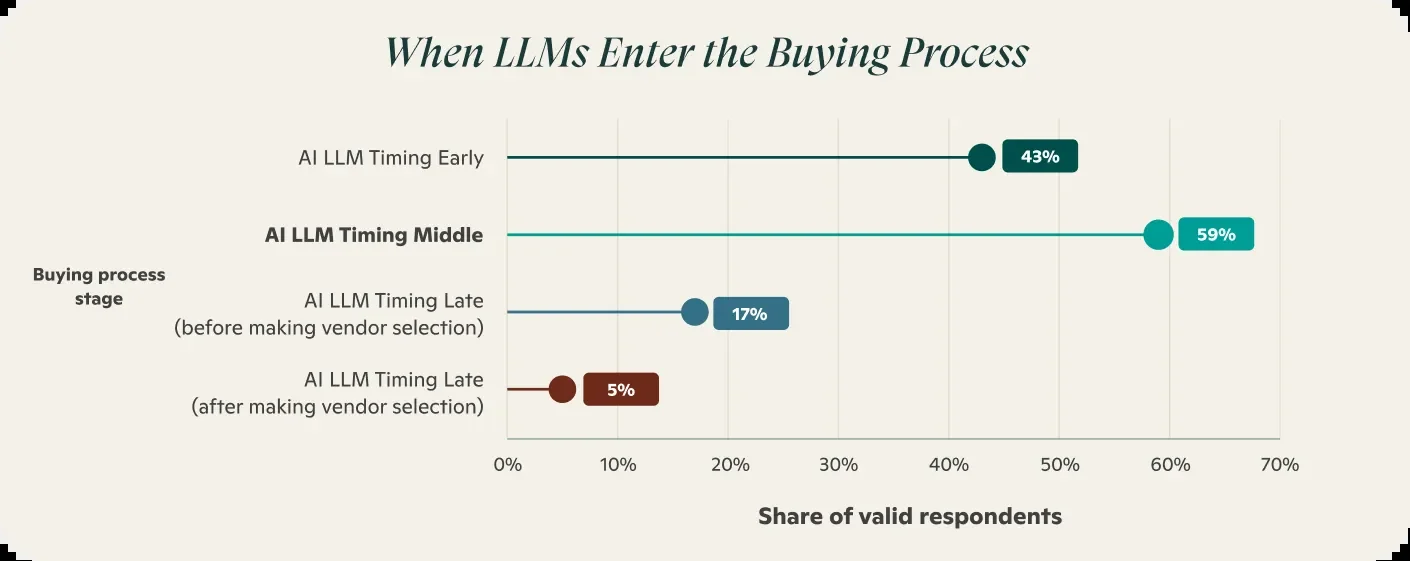
And while AI-generated shortlists are important, we shouldn’t assume they’ve replaced traditional buying behavior. 6sense’s 2026 Buyer Experience Report found that 81% of respondents used large language models during their buying journey. Yet only 17% to 21% considered them influential, and just 26% used them to discover new vendors. That suggests AI tools are often supporting decisions that were already forming, rather than introducing completely new vendors. The shortlist may be changing. The decision process isn’t changing as quickly as some of the predictions suggest.
Your positioning needs to hold up under comparison
Good positioning has always been about explaining who your product serves, what problem it solves, and why it’s a better choice than the alternatives. AI systems make that job both easier and harder.
On one hand, a clear value proposition is more useful than ever. If your positioning is specific and evidence-based, an AI system can find it, understand it, and use it in comparisons. On the other hand, vague positioning becomes much more visible. AI systems don’t respond to aspirational language the way a human reader might. They need concrete details.
That means we should ask ourselves: Do our product pages clearly state what our product does and doesn’t do? Are our integration capabilities, limitations, and requirements documented? Do we have evidence that backs up our claims, or are we relying on adjectives? If the answer to any of those questions is no, it’s worth fixing. Not just for AI, but for human buyers as well.
Your content strategy needs to answer real questions
The shift toward AI-assisted buying doesn’t mean we need to write content specifically for machines. It does mean we need to rethink how our content is structured. Buyers are increasingly asking detailed questions and expecting specific answers. They want to know whether a product supports a particular integration, how it handles a particular workflow, and what implementation actually involves. That’s an opportunity for PMMs.
Comparison pages, integration documentation, implementation guides, and customer stories with measurable outcomes are all more useful in this context than generic thought leadership. But it’s important to be honest about what content can and can’t do. Creating a page titled “best DAM platform” doesn’t guarantee an AI assistant will recommend your product. AI systems pull from multiple sources, including reviews, analyst reports, forums, and your competitors’ websites.
The objective shouldn’t be producing hundreds of pages designed to attract AI recommendations. It should be making the information buyers need easier to find, understand, and verify.
What this means for sales
If AI can explain products and compare vendors, does that make salespeople less relevant? I don’t think so. It changes what buyers expect when they do speak to Sales. A prospect who has already spent hours researching products with AI probably doesn’t need another general overview. They need someone who can validate their assumptions, explain implementation tradeoffs, and address technical concerns.
For PMMs, that means enablement needs to move beyond feature descriptions. Give sellers the evidence to challenge inaccurate AI-generated comparisons. Build concise answers to common objections. And make sure the sales team understands what AI systems are actually saying about your product. If an AI assistant repeatedly recommends a competitor because it incorrectly believes your platform lacks a capability, your sales team should know about that before the prospect does.
How I’d start preparing
I wouldn’t rush to overhaul our entire go-to-market strategy based on predictions alone. I’d start with a simple exercise. Take 20 to 30 questions buyers are likely to ask about your product category. Include use cases, competitors, pricing, integrations, and specific technical requirements. Run those questions through several relevant AI assistants. Then examine the results. Which vendors get recommended? What does AI say about your product? Which sources does it use? Are there inaccuracies, gaps, or outdated information? Document what you find.
Next, work with Product, Sales, and your web team to correct those gaps. Update outdated content, improve documentation, and make sure your positioning is clear and consistent across the sources AI systems are likely to use. Repeat this exercise every few months.
I’d also add one question to win-loss interviews: “Did you use AI to research vendors, and did it influence your decision?” That gives you a direct connection to actual buyer behavior, rather than relying on industry predictions.
What has not changed
There’s a lot of speculation about how AI agents will change B2B buying. Some of it is supported by strong evidence. Some of it is still forecasting. For PMMs, the immediate implications are much more practical. Buyers have new ways to research products, compare alternatives, and validate claims. That means our work needs to be more specific, more evidence-based, and easier to verify.
But let’s not confuse faster research with better decision-making. Enterprise purchases still involve budgets, risk, implementation requirements, and people who are accountable for the outcome. Your next customer might use an AI agent to find you. They might even use one to evaluate you. But they’ll still need a convincing reason to buy. And making that reason clear remains the job of product marketing.
Frequently asked questions
- Are AI agents buying B2B software on their own?
- Not yet. In G2’s 2026 research, only 2% of software buyers said they would allow an AI agent to complete purchases without prior approval, and 9% were comfortable allowing purchases within predefined limits. Agents are researching and shortlisting; humans still approve spending.
- What did Forrester predict about AI agents in B2B buying?
- In October 2026, Forrester predicted that agentic buying will play a role in 75% of B2B purchases in 2027. Playing a role covers research, evaluation, comparison, procurement analysis and other parts of the buying process. It does not mean agents will independently approve three out of four purchases.
- How are B2B buyers using AI chatbots today?
- G2’s 2026 Buyer Behavior Report found that 82% of buyers had sourced recommendations from AI chatbots over the previous two years, and half of those buyers said AI had its greatest influence during shortlisting and evaluation. 6sense found that 81% of buyers used large language models during their buying journey, while only 17% to 21% considered them influential and 26% used them to discover new vendors.
- What should product marketers do first about AI-assisted buying?
- Take 20 to 30 questions your buyers actually ask, run them through the AI assistants they are likely to use, and read what comes back. Note which vendors get recommended, what the AI says about your product, and where it is wrong or out of date. Fix the gaps in your positioning and documentation, repeat the exercise every few months, and add an AI question to your win-loss interviews.